
Flexible
-
 While intravenous needles need to be rigid in order to pierce the skin, that rigidity sometimes causes damage to the veins. A new needle addresses that issue by softening upon insertion into the patient's body.
 -
 Surgeons are increasingly turning to less-invasive techniques, such as utilizing long, thin needles – instead of scalpels – to access targets within the body. A new needle, with a steerable tip, could make such procedures faster and easier.
 -
 Regular ultrasound probes have flat bases, which means they only work best when scanning objects that have similarly-flat surfaces. So, what happens if you want to inspect something that's curved or otherwise "irregular" in shape? Well, that's where a new ultrasound patch comes in.
 -
 A team of researchers from Tufts University has taken flexible electronics to their next logical step, embedding them in sutures that can monitor the body from the site of the stitching and broadcast their findings to a Bluetooth-enabled device.
 -
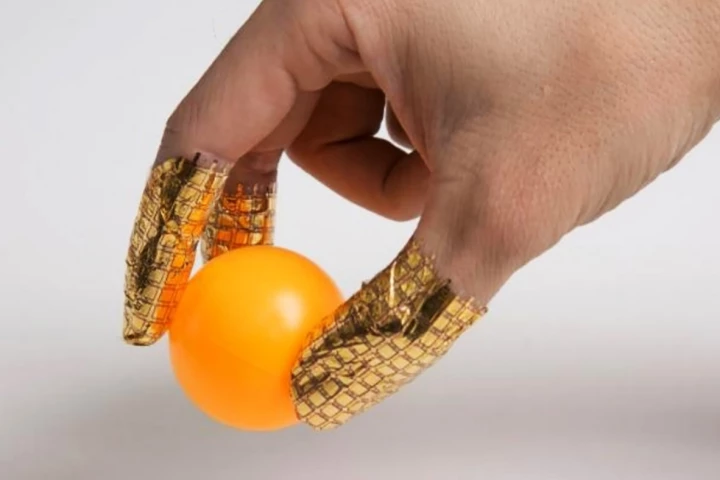 Researchers have developed a thin and flexible pressure sensor that's able to continue to function effectively when curved over a tiny radius.
 -
 A new conductive, transparent, and stretchable nanomaterial that folds up like an accordion could one day be applied to the development of flexible electronics and wearable sensors, as well as stretchable displays.
 -
 Researchers from Karlsruhe Institute of Technology (KIT) and Franz Binder GmbH & Co have developed a new manufacturing process to print EL panels directly onto the surface of almost any convex and concave shape. Even, apparently, onto spheres.
 -
 New help may be on the way for healthcare personnel tasked with monitoring multiple patients. Researchers from the University of Tokyo have created a solar-powered arm band, that sounds an alarm if the wearer's body temperature gets too high.
 -
 Researchers at MIT have used a new method to craft solar cells from ultra-thin layers of quantum dots to set a new record of nine percent for the most efficient quantum-dot solar cells produced to date.
 -
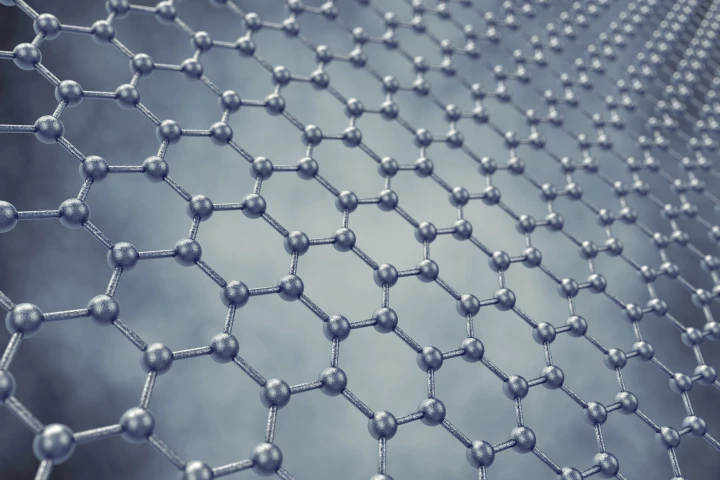 Columbia University researchers have come up with a way to produce large joined sheets of graphene which are just as strong as the material in its pure, crystalline form.
 -
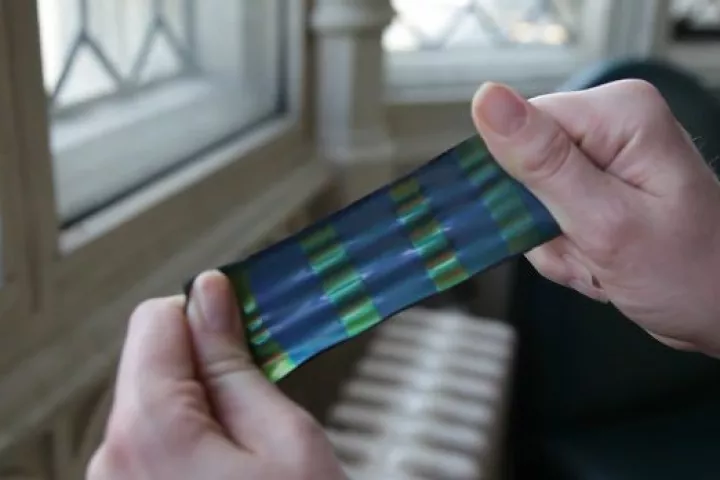 Scientists have created an synthetic elastic opal-like material, that changes color when stretched.
 -
 Scientists have replicated the flexible-but-tough internal structure of the sea sponge, to create a material that might find use in body armor.
Load More