
Explosion
-
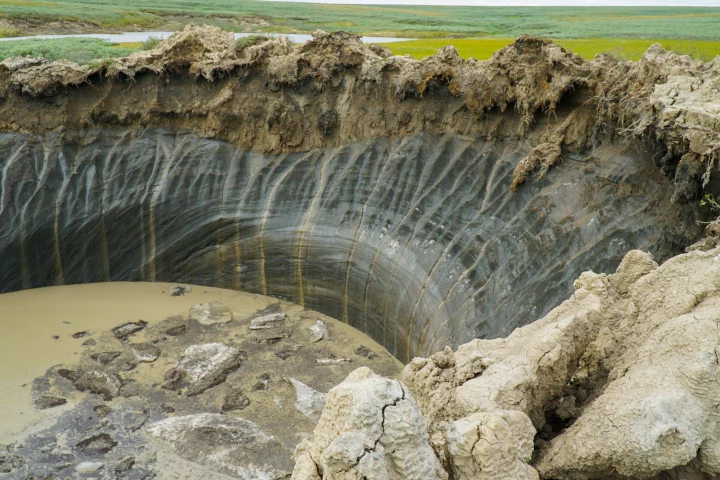 On the remote Yamal and Gydan peninsulas of western Siberia, the landscape is marked by massive craters that look as though the Earth has blown holes in itself. Now, 12 years after the first one was found, scientists say they know what's causing them.
 -
 It feels like every time astronomers get a handle on a cosmic phenomenon, a new one pops up that sends them back to the drawing board. Case in point – Hubble has spotted a burst of light in a region of space where there didn’t seem to be a trigger.
 -
 Astronomers have captured the biggest cosmic explosion ever detected. About 100 times bigger than the solar system and two trillion times brighter than the Sun at its peak, the mysterious miasma has remained visible for three years.
 -
 Supernovae are some of the most energetic events in the universe, and the resulting nebulas are a favorite for stargazers. To better understand the physics behind them, researchers at Georgia Tech have created a “supernova machine” in the lab.
 -
 Gamma-ray bursts (GRBs) are the most energetic events in the universe, second only to the Big Bang itself. We don’t usually get any warning, but now astronomers have spotted the telltale signs of a star system that could blow its lid any moment – and it’s far too close to Earth for comfort.
 -
 A new study is shedding light on a type of binary star system theorized to transition into a state of hibernation lasting thousands of years following powerful nova explosion events.
 -
 Scientists are looking at using impact-absorbing nanofoams in body armor.