
Exomars
-
 A huge deposit of water has been discovered on Mars in a formation often called its Grand Canyon. The Trace Gas Orbiter has detected an area the size of the Netherlands where water could make up as much as 40 percent of the material near the surface.
 -
 Organic compounds have been discovered on Mars in recent years. A new study examines the different ways that one type in particular, thiophene, may have formed, and intriguingly one of the most plausible scenarios involves ancient microbial life.
 -
 Has life ever existed on Mars? Humankind has sent more than a dozen spacecraft to investigate, with some built to dig into the surface and others to roam its dusty terrain. The ExoMars 2020 mission will be the first to do both.
 -
 The ExoMars Trace Gas Orbiter (TGO) has made a map of the distribution of watery minerals in the Martian surface, studied how the global dust storm affected the atmosphere, and intriguingly found very little methane, which calls into question the results of a study just last week.
 -
 One of the software packages that will guide the ESA ExoMars 2020 rover on the Red Planet has passed a major test at the space agency's Planetary Utilisation Testbed. The exercise by the half-scale ExoMars Testing Rover will help the actual rover autonomously navigate Martian hazards.
 -
 Data returned by the ESA-Roscosmos ExoMars Trace Gas Orbiter indicates that astronauts on even short future Mars missions could face significant space radiation hazards and would be exposed to at least 60 percent of their total lifetime career radiation exposure limit.
 -
 After a seven-month investigation, ESA has released the results of its inquiry into the crash of its unmanned Schiaparelli lander on Mars last October. Telemetry data and orbital images show that the accident was due to a violent rotation of the module that fooled the onboard computer.
 -
 While many people are taking it easy for the holiday season, ESA is gearing up for a very busy New Year. On January 19, the space agency will begin a complicated year-long maneuver to radically alter the orbit of the Trace Gas Orbiter around Mars using the Red Planet's atmosphere as a giant brake.
 -
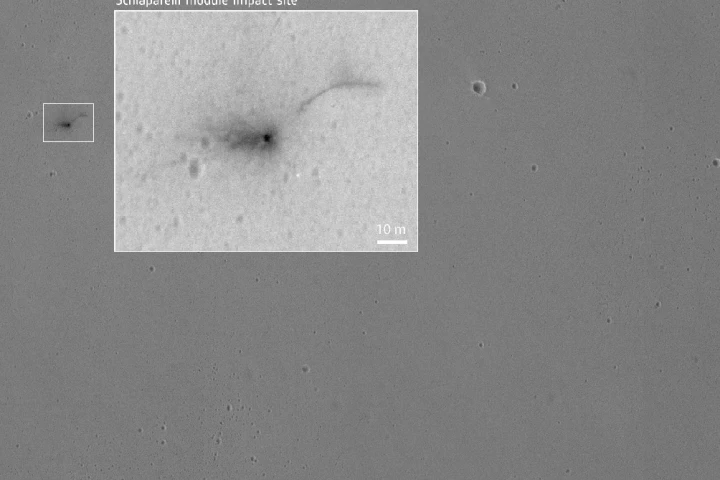 Though exactly what happened to ESA's Schiaparelli lander when it crashed on the surface of Mars is unclear, one possibility is that the unmanned spacecraft shut down its landing engines early because it thought it was already on the ground.
 -
 ESA's Schiaparelli lander module remains out of contact. Data from the Trace Gas Orbiter (TGO) mothership suggests Schiaparelli may have suffered a parachute malfunction during atmospheric entry and crashed on the surface of the Red Planet.
 -
 Today was a mixed bag for ExoMars 2016. While the Trace Gas Orbiter (TGO) arrived safely at Mars, contact has been lost with the Schiaparelli lander module. Mission control lost contact with Schiaparelli shortly before it entered the Martian atmosphere and has not been reestablished.
 -
 Exomars 2018 is now ExoMars 2020 after the Euro-Russian Mars landing mission was officially postponed for two years. The joint ESA/Roscosmos venture has been beset by delays over the past four years and recent setbacks in mission preparations have placed the 2018 launch window out of reach.
Load More