
ESO
-
 The Sun is the biggest fish in our small pond of a solar system, but it’s a mere minnow compared to the whales that dwell out in the cosmos. New telescope images show a gigantic star casually blowing bubbles 75 times bigger than our Sun.
 -
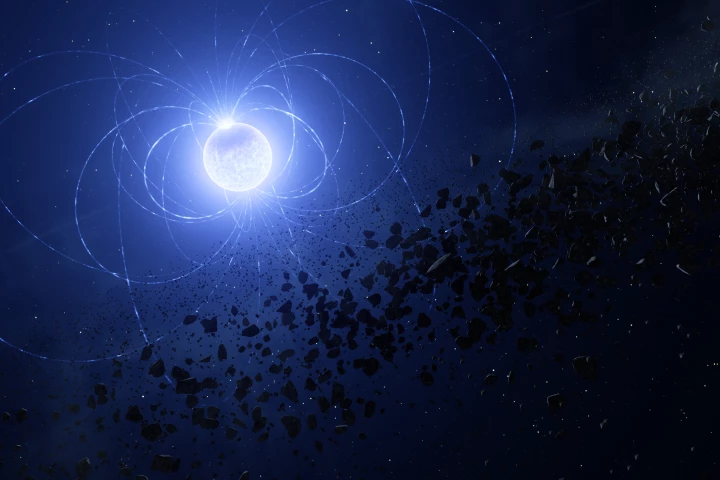 In a few billion years, the Sun will destroy the solar system’s inner planets – and if it’s lucky, it might get a big cool scar to brag about. That’s what happened to a newly found white dwarf, which appears to have a bizarre metal scar on its surface.
 -
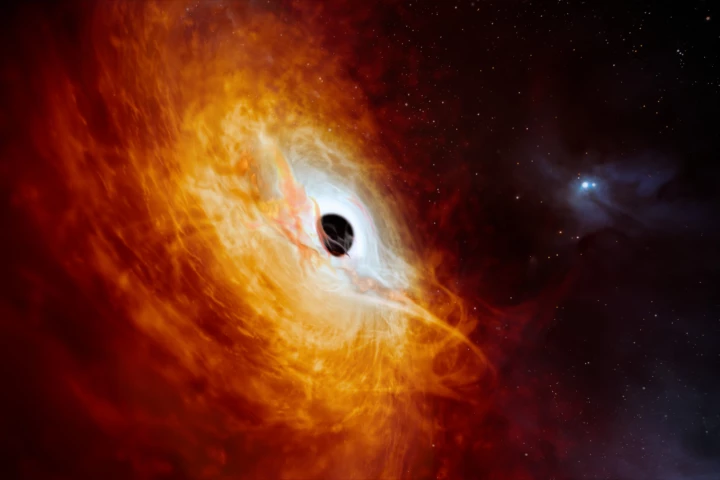 The brightest object in the known universe has just been found. It's a supermassive black hole with the mass of 17 billion Suns, and it swallows another Suns’ worth of material every day, making it also the fastest-growing black hole ever found.
 -
 You can breathe easy and take the sticky tape off the windows because the solar system won't be hit by the rogue white dwarf WD 0810-353 in 29,000 years. ESO’s Very Large Telescope (VLT) shows that early calculations were a bit off.
 -
 Astronomers have discovered a new type of star, which could be key to solving a cosmic mystery. This massive helium star has an ultra-strong magnetic field, meaning it could be the preliminary stage of a magnetar, which so far has unknown origins.
 -
 Able to detect gravitational waves and visible light sources, ESO's BlackGEM telescopic array at La Silla Observatory in Chile is on the hunt for ripples in space-time. And unlike existing observatories, it can pinpoint where they're coming from.
 -
 Astronomers from the Event Horizon Telescope Collaboration have today revealed the first image of the supermassive black hole at the center of the Milky Way galaxy, produced using a network of radio telescopes around the world.
 -
 Astronomers may have detected a new exoplanet around Proxima Centauri, the star closest to our solar system. This tiny new world is one of the lightest ever discovered, which is even more impressive given the technique the team used to find it.
 -
 Astronomers have captured the first clear images of a colossal moon-forming debris disk orbiting a distant alien planet. According to the authors of the new study, the disk has enough material to create three satellites the size of Earth’s Moon.
 -
 The dual disk structure of our home galaxy may not be as unique as once thought, according to the results of a new study that probed the cross section of a spiral galaxy orbiting the Milky Way, some 320 million light years from Earth.
 -
 The first comet known to visit our Sun after being born around an alien star may be the most pristine comet ever discovered, new research has found.
 -
 Astronomers have discovered the aftermath of a cosmic hit-and-run in our own neighborhood. While studying the closest star cluster to the Sun, ESA scientists realized it may have been disrupted by a huge lump of invisible mass, possibly dark matter.
Load More