
Dwarf galaxy
-
 The endless expanse of space is a beautiful and fascinating subject for photography. From the dramatic births and deaths of stars, to galactic glamor shots and planetary close-ups, here are some of the most breathtaking space photos of 2021.
 -
 A star that shined with 2.5 million times the light of our Sun has disappeared from the night sky. It is possible that the star collapsed into a black hole without first triggering a supernova – a rare event, even in the context of dying stars.
 -
 The Hubble Space Telescope has captured a view of a stellar laboratory that is being used to understand how truly gargantuan stars come to form. The image features a colorful starfield and a substructure of the famous Tarantula Nebula.
 -
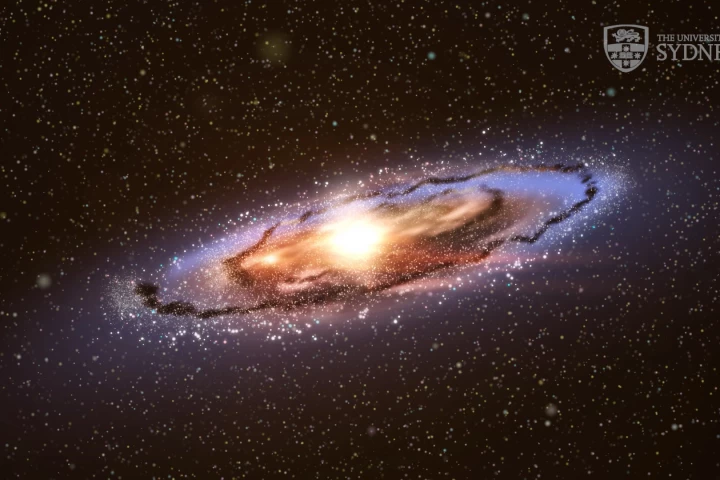 A new study has revealed the violent past of the Andromeda galaxy, by identifying the remains of its galactic victims.
 -
 Last year astronomers discovered a gigantic “ghost” galaxy, named Antlia 2, orbiting the Milky Way. Now, new research led by Rochester University has found that the bizarre galaxy may have been involved in a hit-and-run that left the Milky Way with a wobbly galactic disc.
 -
 Astronomers have discovered a star in the Milky Way that doesn’t belong. Known as J1124+4535, the star has a chemical composition unlike any others ever observed in our home galaxy, suggesting it’s an intergalactic interloper that may have come from a dwarf galaxy swallowed up by the Milky Way.
 -
 According to a new study, the Large Magellanic Cloud, a nearby dwarf galaxy, is on a collision course with the Milky Way. But there’s no need to worry just yet – the starry smashup won’t begin for another two billion years or so.
 -
 An international team of astronomers has now found evidence of a celestial smash-up between the Milky Way and an unknown dwarf galaxy that took place around eight to 10 billion years ago, and forever changed the face of our home galaxy.
 -
 Astronomers have captured the most detailed view to date of the region of space surrounding the famous Tarantula Nebula – a 1,000 light-year wide swirling cloud of cosmic gas, the core of which is illuminated by some of the brightest and most massive stars ever detected.