
Durham University
-
 A fascinating new look into the private lives of apes has found that chimps settle conflict with friends with genital contact, much like their bonobo cousins. This sheds light on where our own sexual behavior originates, some six million years ago.
 -
 Some 19 years on from an initial hint, the same UK astronomers have discovered one of the biggest black holes known to date. They also believe the technology on hand for their findings will help shed new light on one of space's biggest mysteries.
 -
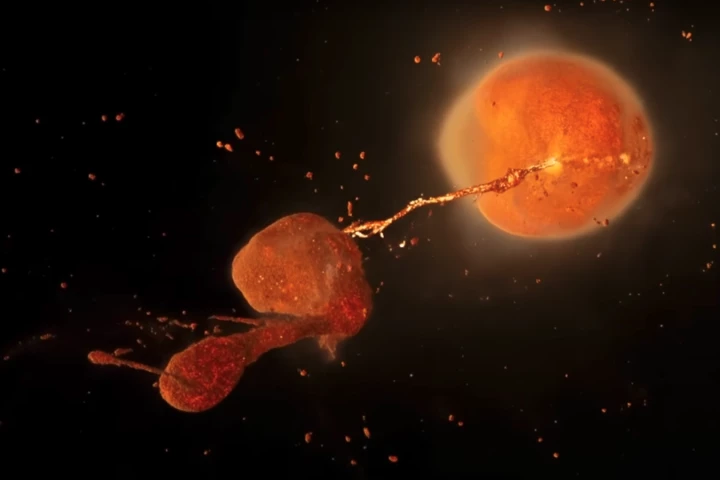 It’s believed that the Moon formed billions of years ago, from debris from a cosmic collision with Earth. New high-resolution simulations not only illustrate the idea in stunning detail, but reveal that the Moon’s birth might have taken mere hours.
 -
 Scientists studying the movement of seafloor sediment have found that underwater avalanches are driving microplastics into the deep ocean, which may help researchers better map the distribution of waste throughout the marine environment.
 -
 According to a new study, the Large Magellanic Cloud, a nearby dwarf galaxy, is on a collision course with the Milky Way. But there’s no need to worry just yet – the starry smashup won’t begin for another two billion years or so.
 -
 Our universe seems to contain a suspiciously perfect amount of "dark energy" to sustain life. But new research suggests that life is still possible even with far more dark energy than we have, and the results have some big implications for the multiverse theory.
 -
 When most people think of helium, they think of party balloons and funny voices, but the gas has far more important applications in medicine and electronics. Unfortunately, the world has been in the grips of a global shortage. Now, a research team has discovered a massive reserve in East Africa.
 -
 An international team of astronomers is planning to use gravitational wave data to unravel the formation processes that created the first supermassive black holes.
 -
 Researchers at Durham University in the United Kingdom have developed an approach to breaking down rubber in materials at room temperature. The chemical process uses catalytic disassembly, eliminating the energy-intensive methods of currently-used tire recycling methods.
 -
 A new technique that generates human hair growth from a patient's own cells could make hair transplantation feasible for those suffering male- and female-pattern hair loss, scarring alopecia, and hair loss due to burns.
 -
 In a recent study, multi-user multi-touch desks were found to help students do better at math.