
Dresden University of Technology
-
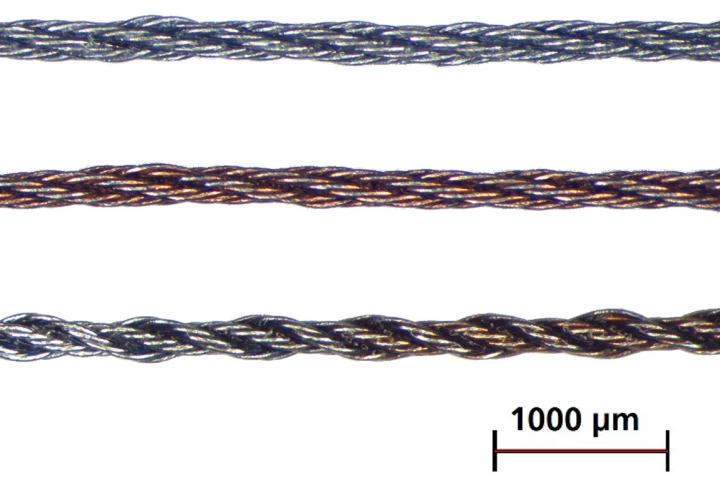 The leads that connect external pacemakers to the heart can potentially cause problems, either if they're removed or left in place. German scientists are therefore developing an alternative, in the form of leads that get absorbed by the body.
 -
 The liver can regenerate itself after taking damage, but whether that ability fades with age is unknown. A new study has found that age doesn’t slow down the liver’s regeneration, and whether you’re 20 or 80, your liver is on average just three years old.
 -
 Superconductivity occurs when electrons in a metal pair up. Scientists in Germany have now discovered that electrons can also group together into families of four, creating a new state of matter and potentially a new type of superconductivity.
 -
 Although we've already heard about plants that mimic the smell of rotten meat in order to attract scavengers, botanists have now discovered that a certain plant focuses that concept – it mimics the smell of dead beetles, to draw in one type of fly.
 -
 Many "cold chain" items such as food or medicine are shipped in single-use expanded polystyrene foam (EPS) packaging, which is difficult to recycle and non-biodegradable. Such is not the case with a new material, however, made from discarded paper.
 -
 Currently, package labels contain certain information – such as barcodes, serial numbers or buyers' addresses – that would be best left unseen by wrongdoers. Newly-developed rewritable labels could address that issue, as they're blank and transparent unless exposed to a certain type of light.
 -
 Several experiments have shown that the EMDrive can generate thrust from basically nothing – in apparent violation of Newton’s Laws of Motion. Unfortunately, a German team has now built and tested their own EMDrive, and found that environmental factors may have been responsible for false positives.
 -
 A long sought-after "nanograss" structure promises to significantly boost the efficiency of organic solar cells by capturing light more efficiently while also allowing the use of cheaper, lower-grade materials.