
Continental
-
 Oceanic manta rays make extreme dives of more than 1,200 meters – three-quarters of a mile – but it's not to feed. Instead, the mantas are calibrating their own kind of Google Maps as soon as they find themselves out beyond the continental shelf.
 -
 New modeling from researchers at Curtin University has simulated 300 million years of tectonic plate movement to predict the formation of a supercontinent called Amasia. The modeling estimates the Pacific Ocean closing and America colliding with Asia.
 -
 Geologists claim to have discovered a long-term cycle that may link the formation of Earth’s continents to our travels through the galaxy. The team claims a correlation between increased comet impacts and Earth crossing the galactic spiral arms.
 -
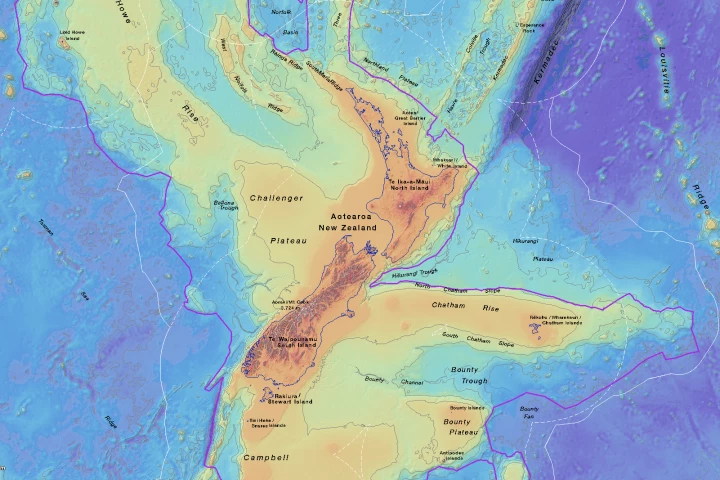 Newly released maps of Zealandia, a massive sunken landmass, are revealing the topography of this underwater land in unprecedented detail. An interactive website has also been launched allowing users dynamic ways to explore the new data.
 -
 When did Earth's plate tectonics begin? A new study from Yale University claims to have found evidence that plate tectonics started about a billion years earlier than is currently thought, which places it very soon after the planet’s formation.
 -
 As any high school student will tell you, Earth has seven continents. Now researchers from Australia and New Zealand are challenging this fundamental notion by proposing an eighth continent in the oceans east of Australia, dubbed Zealandia.