
Collision
-
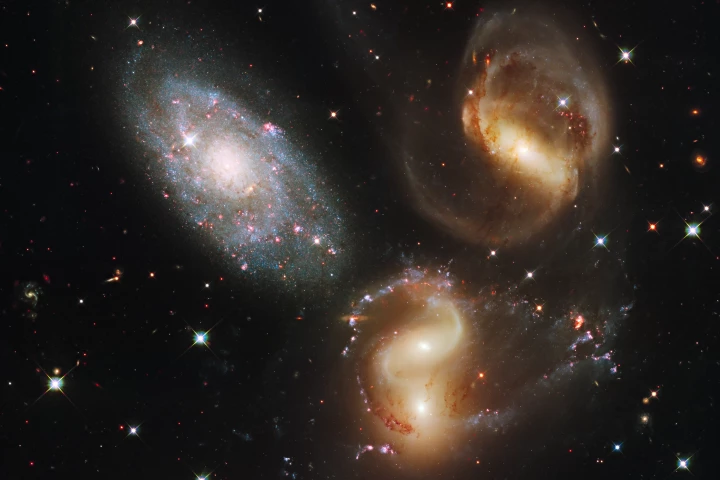 Astronomers have clocked a cosmic collision at 3.2 million km/h (2 million mph). A new instrument has spotted a galaxy crashing through a group of others at incredible speeds, creating a shock wave that’s changing the region completely.
 -
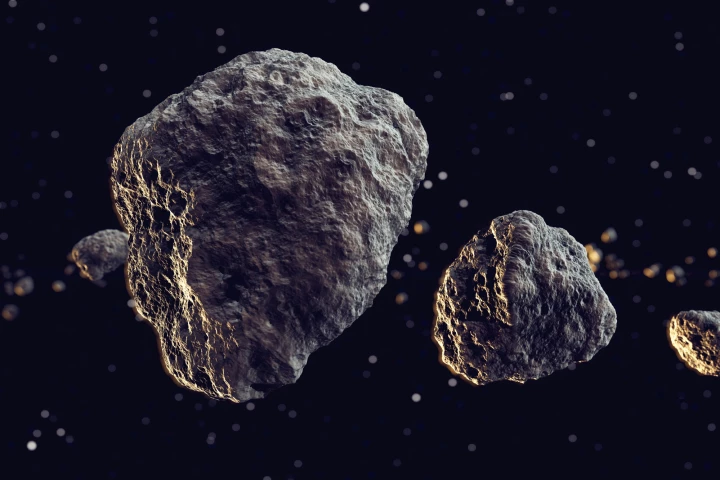 In 2029, a large asteroid will whizz past Earth so close it’ll be visible to the naked eye. But could collisions with other asteroids bounce it off-course into us? To find out, astronomers have now crunched the paths of 1.3 million known asteroids.
 -
 Self-driving cars typically use radar or LiDAR technology to avoid collisions with other vehicles. Scientists have now created a much simpler insect-inspired system that could serve the same purpose more efficiently – at night, that is.
 -
 Astronomers have discovered three new near-Earth asteroids, including the closest known to the Sun. Another is one of the largest known asteroids considered potentially hazardous to Earth, measuring almost a mile wide with an orbit close to our own.
 -
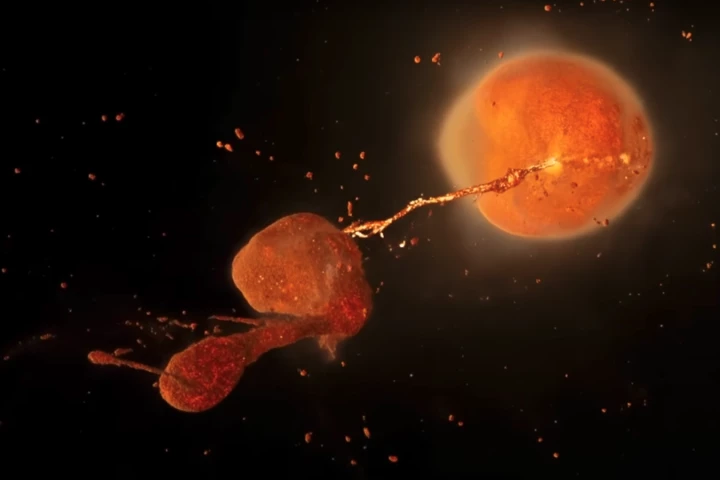 It’s believed that the Moon formed billions of years ago, from debris from a cosmic collision with Earth. New high-resolution simulations not only illustrate the idea in stunning detail, but reveal that the Moon’s birth might have taken mere hours.
 -
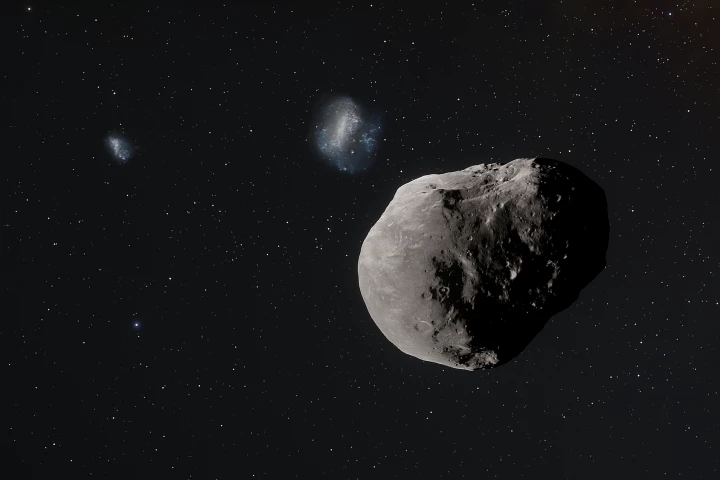 Asteroid Apophis has attracted its share of attention, with several projected close shaves with Earth in the coming decades. While most have been ruled out, a previously-overlooked factor has opened a small window for a possible collision in 2068.
 -
 Data from the Juno probe found that Jupiter's core is less dense and more spread out than expected. Now, astronomers believe they have an answer – a huge ancient planet, with 10 times the mass of Earth, crashed into the gas giant in the early days of the solar system.
 -
 Of all the things you don’t want to lose, an asteroid with a chance of striking Earth is pretty high up the list. A potentially dangerous space rock called 2006 QV89 has been missing in action for 13 years, but now astronomers have finally found it, and ruled out an impact within the next century.
 -
 Galaxies smash into each other on a pretty regular basis, usually merging together. Using data and observations from Hubble and the Keck Observatory, astronomers have now imaged the late stages of this incredibly slow process for the first time.
 -
 According to the results of a new study, Uranus may have survived a dramatic collision with a protoplanet twice, or even three times the size of Earth roughly four billion years ago, back when the solar system was young.
 -
 It's been suggested that asteroids delivered water to a bone-dry early Earth, but whether that would work in practice remained unanswered. Now scientists at Brown University have tested the theory using a high-powered cannon, and found that a surprising amount of water is transferred in the process.
 -
 A new study that analyzed isotopic differences in potassium contained in terrestrial and lunar rock samples, is helping to shed light on the formation process that led to the creation of Earth's Moon.
Load More