
Brown dwarf
-
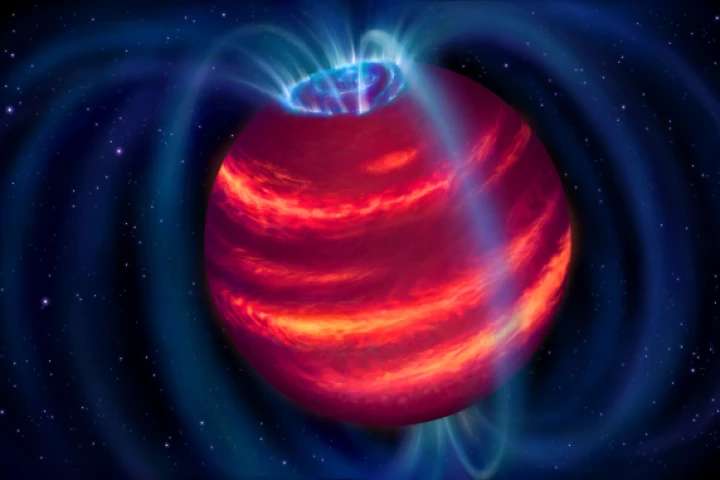 Scientists in Europe and Hawaii have scored a world's first by detecting a "super-planet," also known as a cold brown dwarf, using a radio telescope. Located 212 light-years away, BDR J1750+3809 may help in the search for habitable exoplanets.
 -
 Using polarized light, astronomers have detected signs of cloud bands in the atmosphere of a brown dwarf far beyond the solar system. It turns out that these gassy giants have a similar appearance to Jupiter, and the same kind of wild weather.
 -
 Astronomers have discovered a rare superflare more powerful than anything observed on our Sun in modern times, erupting from a small, cold star roughly the size of the planet Jupiter.
 -
 A brown dwarf was recently downgraded to planet status (albeit a huge one), and now astronomers have discovered that it generates an enormous magnetic field, which could provide a new tool in the search for exoplanets.
 -
 You might have a pretty clear mental picture of what a planet is, but the official definition is surprisingly contentious. Now, an astrophysicist from Johns Hopkins University has proposed a revision to the definition of a planet, to help differentiate gas giants from brown dwarfs.
 -
 When you're dealing with astronomical bodies that are light years away from you, sometimes classifications can be tricky. That seems to be the case with SIMP0136, an object located in a 200-million-year-old group of stars called Carina-Near.
 -
 An international team of astronomers from the US, Europe, Chile, and South Africa have identified a star system that most likely passed through the outer edge of our solar system at a distance of 0.8 light years some 70,000 years ago.
 -
 Astronomers using NASA's Wide-field Infrared Survey Explorer (WISE) and Spitzer Space Telescope have discovered a dim star-like “brown dwarf” about 7.2 light years from Earth that's colder than the North Pole.
 -
 PSO J318.5-22 is an exoplanet discovered this year by astronomers at the University of Hawaii that is floating through interstellar space without a parent star and is one of the smallest free-floating objects seen outside of the Solar System.
 -
 A binary stellar system consisting of a pair of brown dwarf stars has been discovered at a distance of only 6.5 light years, making these the fourth and fifth closest stars to the Sun.