
Big Bang Theory
-
 Everything has to end eventually – including the universe itself. It might be hard to imagine a catastrophe big enough to affect the entirety of existence, but here are some of the leading hypotheses about how the universe could end, and when.
 -
 A new model by a team of scientists led by Yale University suggests that the ever elusive dark matter that has so far escaped the detection of scientists may be trapped inside primordial black holes left over after the Big Bang.
 -
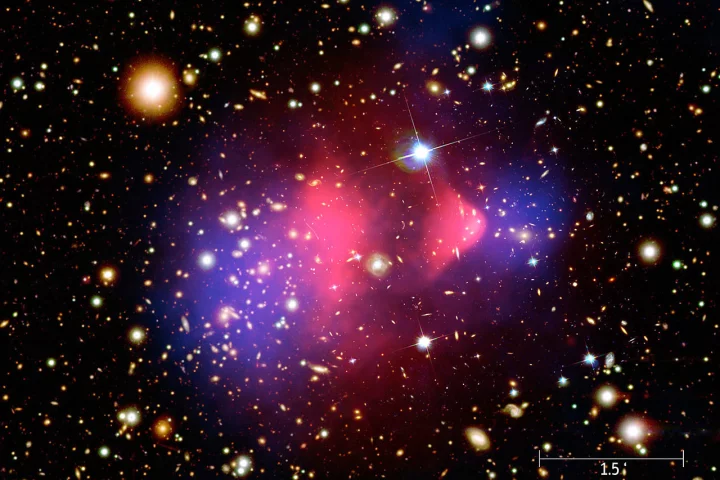 How did the universe end up with exactly the amount of dark matter needed? A new model suggests dark matter particles in the early universe converted regular matter into dark matter exponentially, before being slowed by the expansion of the universe.
 -
 In January scientists reported the detection of very low-frequency gravitational waves. Now astrophysicists have investigated two possible sources – the universe cooling down after the Big Bang, and a field of particles that could be dark matter.
 -
 The universe likes to play coy about its age, but we have a pretty good idea of the range. Now, a series of new studies has investigated the question using different methods, and have reached different answers, separated by more than a billion years.
 -
 Equal amounts of matter and antimatter should have been created in the Big Bang, but this would just have annihilated itself. Now, physicists have proposed a new theory that explains the mystery – and outlined how we can find direct evidence of it.
 -
 Few things are as mysterious as dark matter. Now, a physicist from Johns Hopkins University has outlined a new theory that helps to explain the stuff but at the same time makes it seem even more bizarre. According to the study, dark matter may have originated before the Big Bang.
 -
 Astronomers have finally found the very first molecule to ever form in the universe. The helium hydride ion (HeH+) has long been a key theoretical part of how the chemistry of the cosmos kicked off. Now the first unambiguous evidence of the molecule in a planetary nebula has been found.
 -
 Astronomers have identified one of the oldest stars ever found, which appears to be just one generation removed from the beginning of the universe itself. Being relatively close to Earth, the find could mean our galactic neighborhood is much older than previously thought.
 -
 Elements like oxygen, carbon and nitrogen weren’t very common until the first stars had fired up, burnt out and exploded. Now, astronomers using ALMA have detected the most distant – and hence, earliest – signature of oxygen, in a galaxy 13.28 billion light-years away.
 -
 Renowned physicist Stephen Hawking passed away earlier this year, but his legacy to science will live on. His final theory on the origin of the universe has now been published, and it offers an interesting departure from earlier ideas about the nature of the “multiverse.”
 -
 To look through space is to look through time. Astronomers have now peered right back to the “Cosmic Dawn” – when the first stars were beginning to fire up – by picking up an extremely faint radio signal that marks the earliest evidence of hydrogen, just 180 million years after the Big Bang.
Load More