




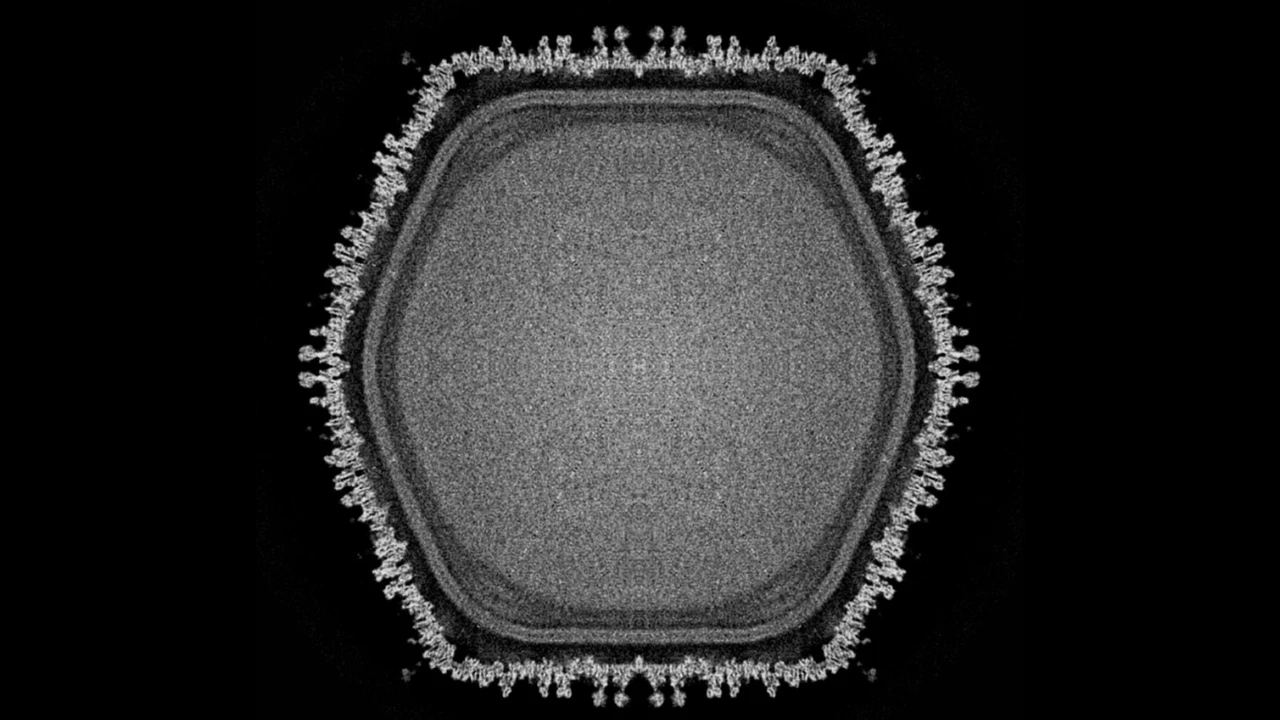

For more than two decades, giant viruses have unsettled one of biology’s most fundamental boundaries: the line between simple viruses and complex cells. With genomes rivaling some bacteria, and gene sets that resemble those of eukaryotes (cells with membrane-bound nuclei and other internal compartments), they have forced scientists to rethink how cellular complexity may have emerged. A newly discovered giant virus now sharpens that debate, offering fresh clues about how the defining feature of most complex life, the nucleus, may have evolved.
In a study published in the Journal of Virology, researchers have describe ushikuvirus, a large DNA virus isolated from a freshwater pond in Ibaraki Prefecture, near the Tokyo metropolitan area. The virus infects the amoeba Vermamoeba vermiformis. Genetic comparisons place it closest to clandestinovirus, forming a distinct branch that sits near the giant DNA virus family Mamonoviridae, which includes the nucleus-interacting medusaviruses.
That relationship matters because medusaviruses have long occupied a provocative position in evolutionary debates. Medusavirus replicates its genome inside the host cell nucleus and encodes several eukaryote-like proteins, including a full set of histones, proteins that help package and organize DNA.
In 2001, researchers Masaharu Takemura and Philip Bell proposed what became known as the viral eukaryogenesis hypothesis, suggesting that a virus-like “virion factory” in an ancestral cell may have evolved into the modern eukaryotic nucleus. In other words, the idea argues a key evolutionary step towards complex life like plants and animals was triggered by a virus infecting another cell.
Ushikuvirus enters that debate as both a relative and a complication. Like medusavirus, it encodes a full set of histones. But its behavior inside the cell diverges in a striking way.
“Ushikuvirus also encodes eukaryote-like proteins such as full-set of histones but has an interestingly different mechanism to replicate its genome," Takemura explained to Refractor in an email. "Ushikuvirus destroys its host nuclear membrane and makes a ‘virion factory’ in former nuclear site."
Rather than replicating inside an intact nucleus, ushikuvirus dismantles the nuclear membrane and establishes its replication center in what had been nuclear space. Closely related viruses, in other words, appear to have adopted different strategies for interacting with one of the defining structures of complex cells.
Takemura cautions that ushikuvirus is only one relative within this broader viral group and does not, by itself, strengthen the viral eukaryogenesis hypothesis. Instead, he argues that researchers must better understand how virus–nucleus interactions have changed across different evolutionary branches, particularly between the medusavirus system and the ushikuvirus system.
Host differences add another evolutionary layer. Medusaviruses infect one major lineage of amoebae, while ushikuvirus infects a different group. That split suggests that closely related giant viruses may have followed different evolutionary paths as they adapted to distinct cellular environments.
Structural differences between the viruses may help explain that divergence.
“In the case of ushikuvirus, it had appeared that a part of capsid proteins possesses a carbohydrate chain on their surface, but medusavirus does not," Takemura explains. "So, I hypothesize now that the difference of the structure of capsid surface between medusavirus and ushikuvirus caused host-switching.”
High-resolution imaging supports that possibility. Ushikuvirus forms an icosahedral capsid, a geometric shell that protects the viral genome, roughly 250 nanometers across, studded with spikes and distinctive cap structures not seen in medusaviruses. Some of these caps carry fibrous extensions, and laboratory staining suggests glycan components, complex sugar molecules, may decorate parts of the viral surface. Such modifications are thought to influence how viruses recognize and attach to host cells, potentially shaping host specificity over evolutionary time.
On the evolutionary tree, ushikuvirus does more than add another example to an existing family.
“The closest relative of ushikuvirus is previously known clandestinovirus, discovered in France,” Takemura said. He added that additional related viruses, including a recently identified usurpativirus and another unnamed isolate from Japan, appear to form a distinct grouping.
“It is clear that a new family consists of these 4 viruses, which is close to the family Mamonoviridae. So, the discovery of ushikuvirus will refine the phylogeny of the class Megaviricetes, including a new order, a new family, and the family Mamonoviridae.”
Rather than rewriting the origin story of complex life, ushikuvirus refines the viral side of that story. By expanding the diversity of known viruses that interact with the nucleus and clarifying how they diverged, it sharpens the evolutionary framework against which broader hypotheses are tested.
The next step, Takemura says, is comparative. His team plans to search for additional relatives of ushikuvirus in environmental samples and to examine more closely how different giant viruses remodel or interact with the host nucleus. Only by expanding the catalog of nucleus-associated viruses and mapping their evolutionary relationships, he argues, can researchers determine whether viral factories merely resemble nuclei or represent ancestral blueprints for them.
