

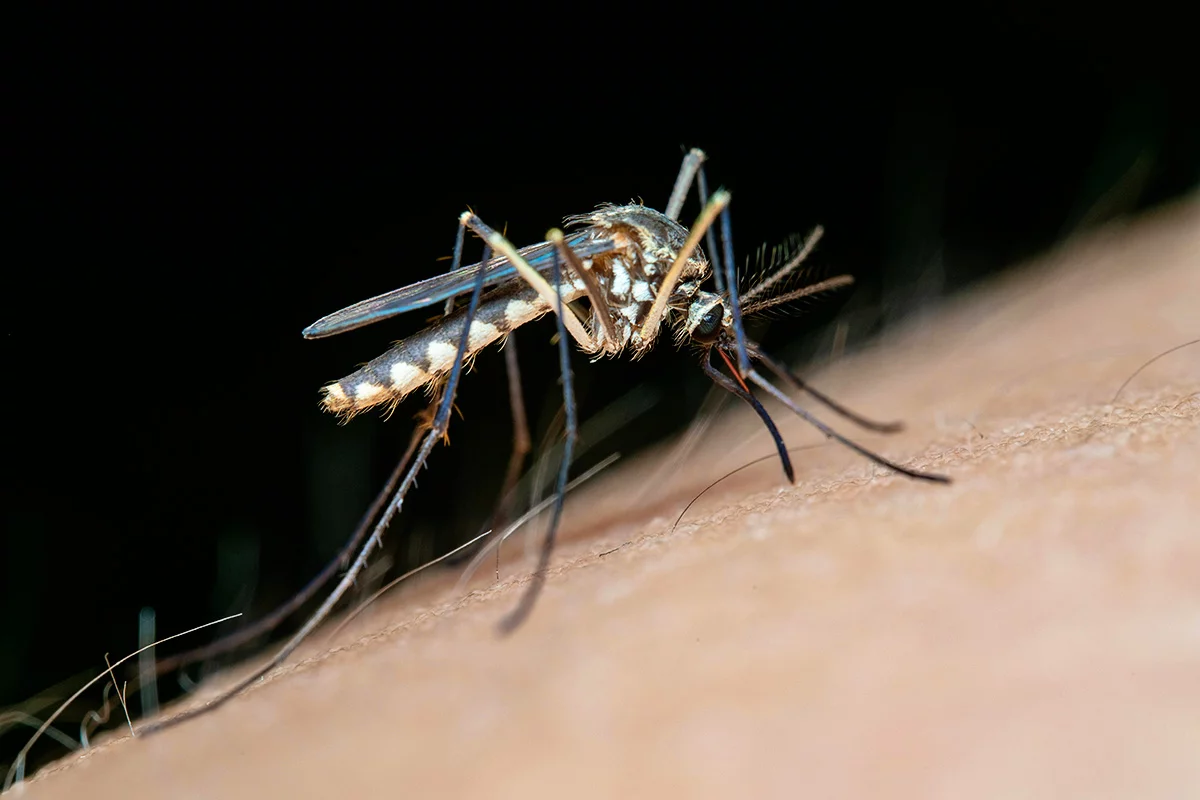

Some of us get bitten far more often than others. A new study, yet to be peer-reviewed and published in a journal, has revealed that certain mosquito species show a clear preference for men, while others zero in on specific scents from our skin. However, some experts in the field disagree on the significance of the findings.
Mosquitoes are among the foremost adversaries of humans. They've been biting us and our ancestors for over a million years, helpfully transmitting serious diseases like dengue, Zika, yellow fever, and malaria. Scientists have long known that mosquitoes use a combination of cues, including carbon dioxide, heat, and odor, to locate hosts. Still, human scent is a complex space comprising over 1,000 volatile organic compounds and the skin microbiome, making it hard to determine exactly which odors are attracting mosquitoes.
While previous studies have shown that humans do vary in how attractive we are to biting insects, no study has yet cross-compared the attraction rates of different mosquito species to individual humans.
To compare how multiple mosquito species would respond to the same people, Matthew DeGennaro and his colleagues tested the attraction of three mosquito species - Aedes aegypti, Aedes albopictus, and Culex quinquefasciatus – to 119 human study participants. The first two species are the main vectors of dengue, Zika, and chikungunya. Meanwhile, the third transmits West Nile virus.
The team used a device called a Uniport olfactometer to quantify how many mosquitoes flew towards a specific scent source. Participants placed an arm in the device to expose mosquitoes to their scent.

Among the three species, Ae. aegypti was highly human-specialized, with an average 89% of the released mosquitoes drawn to human scents. This was the only species that showed a significant preference for male individuals over females.
The study found that different mosquito species favor distinct human scents. The presence of compounds such as ketones was linked to higher attraction for Ae. albopictus, while their absence correlated with attraction for Ae. aegypti and Cx. quinquefasciatus.
“Each mosquito species exhibited distinct responses to individual humans, emphasizing both unique and shared cues for targeting their hosts,” the researchers note in their paper.
The team also found that different mosquito species are usually not attracted to the same participants. The people who were magnets for Cx. quinquefasciatus were often completely different from those favored by the Aedes species.
We contacted mosquito expert Jeronimo Alencar, researcher in Public Health at the Oswaldo Cruz Foundation and Head of the Diptera Laboratory at the Oswaldo Cruz Institute - who was not involved in this study - for an assessment of how significant this research is. “The discovery that different mosquito species prioritize different people based on their unique chemical signatures represents a major advance in the field (vector biology),” Alencar told Refractor via email.
Alencar eplained that Ae. aegypti is highly adapted to urban environments, while Ae. albopictus is originally a forest-edge species. Explaining why two closely related species use different cues for attraction, he said, “If one lineage starts exploiting a different subset of the human population, or a different time of day, both can coexist without one excluding the other.”
“It's a paradigm shift from ‘what attracts mosquitoes’ to ‘who attracts which mosquito,’” Alencar concluded.

However, several other researchers in vector biology were more cautious and skeptical about interpreting the study. They noted that the reported effects, such as the sex-based preference for Aedes aegypti, appear quite small and may be harder to reflect in real-world settings, once noise from the surroundings is factored in. Others highlighted that mosquitoes’ preferences may differ across geographies; local mosquito lineages and the genetic background of the human population can influence the outcomes.
Moreover, the researchers also stressed the difference between controlled lab experiments and natural settings. The devices used in the study, such as olfactometers, often overlook factors like CO2, heat, humidity, and even visual cues like color.
These caveats don't invalidate the observations made in the study, but they highlight important methodological and conceptual limitations to consider when considering any broader implications.
Richard Wall at the University of Bristol, who was also not involved in the study, told us that individual variation in attraction is well documented, driven by differences in body temperature and odor. “So differences in the response of biting insects are to be expected,” Wall says. “It’s a correlational study, not experimental.”
The study has been published in BioRxiv.